
Business internet for retail stores
A store does not need much bandwidth. It needs the card machine to work with a queue at the counter, which is a completely different requirement.
- 1:1 uncontendedThe bandwidth is yours
- SymmetricUpload matches download
- 99.5% uptime SLAWith a 4 hr fault response target
- Surveyed per siteA free survey, then a written quote
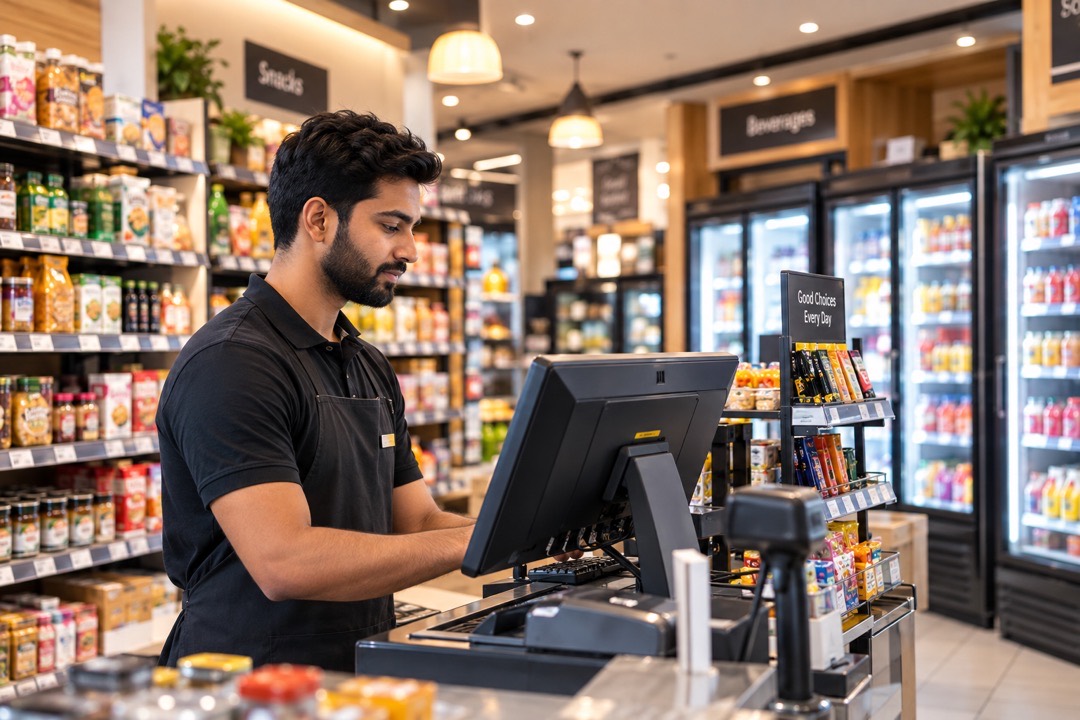
What goes wrong at the counter
Six things retailers tell us, and every one of them happens in front of a customer.
The customer is standing there. A card or UPI terminal that cannot reach its host is the most expensive thirty seconds in retail.
A contended line is slowest when the street is busiest, which is also when the queue is longest.
Cloud inventory means every lookup and every sale is a round trip. Latency is felt at the counter, not on a speed test.
Continuous upload, and footage that has to be there when there is a dispute or a claim.
Five stores on five providers means five bills, five support numbers and no idea which one is actually down.
The person troubleshooting the router is serving the queue that formed because of it.
Sized against the counter, not the catalogue
What each requirement turns into once it is surveyed.
| What the plant needs | What we put behind it |
|---|---|
| Payments that always go through | A 1:1 uncontended circuit (small is fine, shared is not), with a 99.5% uptime SLA in writing. |
| A till that cannot stop | A second path on a different route, so a cut cable does not close the counter. This is the cheapest insurance in retail. |
| Stock and POS that answer instantly | A short, predictable route to the cloud, because a lookup at the counter is about latency rather than size. |
| Several stores, one view | Every branch on one network, one bill and one support contact, so you know which store is down and so do we. |
| Cameras and a claim months later | Headroom for continuous upload and static IPs where the footage has to be reachable from outside. |

Counter, stockroom and head office as one network
What sits in the store, what it has to reach, and our network in between.
- POS and card terminals
- Stockroom and scanners
- CCTV
 Business network
- Cloud inventory
- Payment processors
- Head office and other stores
Multiple possibilities
- Uncontended, so the counter is never queued behind anything
- A second path where a till cannot stop
- Every store on one network and one bill
- 24×7 NOC monitoring on each site
Four ways to connect a store
A single store is business broadband territory. The backup path is what most retailers actually come for.
Symmetric fiber sized for a working day rather than an evening of streaming.
Learn moreA second path, so one cut cable is not the end of the day.
Learn moreEvery branch on the same network, billed and supported as one.
Learn moreA fixed address, for anything that has to be reachable from outside.
Learn moreOrganisations already on our network
91 businesses and institutions across Maharashtra run on Gazon connectivity, grouped here the way our own capability deck groups them.
























































































What a store’s line carries in a trading day
Eight things that are small, constant and unforgiving.
The thirty seconds you cannot afford to lose.
Every lookup is a round trip.
Continuous upload, and a claim months later.
Deliveries that have to be booked in.
Sales figures that are expected nightly.
Kept well away from the till.
Small traffic at every transaction.
The same store doing several times the volume.
From enquiry to a running line
Four steps, and what each one settles.
- 01Tell us the siteThe address, what the connection has to carry, and whether there is more than one location.
- 02We survey the addressHow far our fiber is from your door, and what the route to it involves. Free, and no obligation.
- 03A written quotePriced against that route rather than against an average, with the lead time and the SLA on it.
- 04Install, test, monitorWe build it, test end to end, and the link joins the 24×7 NOC.